A proprietary blend lists several ingredients under one name with a single total weight, so you cannot see how much of each one is in a serving. Printed individual amounts let you compare products, check dose against daily needs, avoid doubling up with other supplements and give your doctor accurate information.
Key takeaways
- A blend shows one total weight, not the amount of each ingredient
- Long ingredient lists can hide tiny, token amounts
- Printed amounts let you compare, add up and share with your doctor
- Prefer labels that show amounts for the nutrients they promote
The impressive label that tells you nothing
Picture two beauty supplements side by side. One lists eight nutrients with an amount next to each. The other lists twenty ingredients, many with exotic names, inside a single blend of 500 mg. Which looks better?
Most people instinctively pick the longer list. More ingredients feels like more value. But that second label might contain only a pinch of the ingredients you actually care about, and there is no way to tell.
That is the problem with proprietary blends, and it is why this site keeps coming back to one simple idea: printed amounts matter.
What a proprietary blend actually is
A proprietary blend is a group of ingredients listed together under a brand-created name, such as a Radiance Complex or a Beauty Matrix. The label shows the total weight of the blend and lists the ingredients in descending order by weight, but it does not have to show how much of each one is present.
Brands often say this protects their formula from copycats. That can be a genuine concern. But it also means you, the buyer, have to take the formula on trust. You are paying for the ingredient list on the front of the box without any way of checking whether those ingredients are present in amounts that could plausibly matter.
Quick tip: In a blend, the first ingredient is the heaviest. Anything listed near the end could be present in a very small amount.
Four problems blends create for you
- You cannot compare value. Without amounts, there is no fair way to compare two products, or to compare price per useful dose.
- You cannot spot token doses. A trendy ingredient may be included mainly so it can appear on the front label.
- You cannot add up overlap. If you also take a multivitamin, you need to know your total intake of nutrients such as vitamin A and zinc. Our guide to taking Gelagen with a multivitamin explains why this matters.
- You cannot inform your doctor. Before blood tests or during pregnancy, specific amounts matter. See the biotin blood-test warning and our note on pregnancy and vitamin A.
How Gelagen handles its label
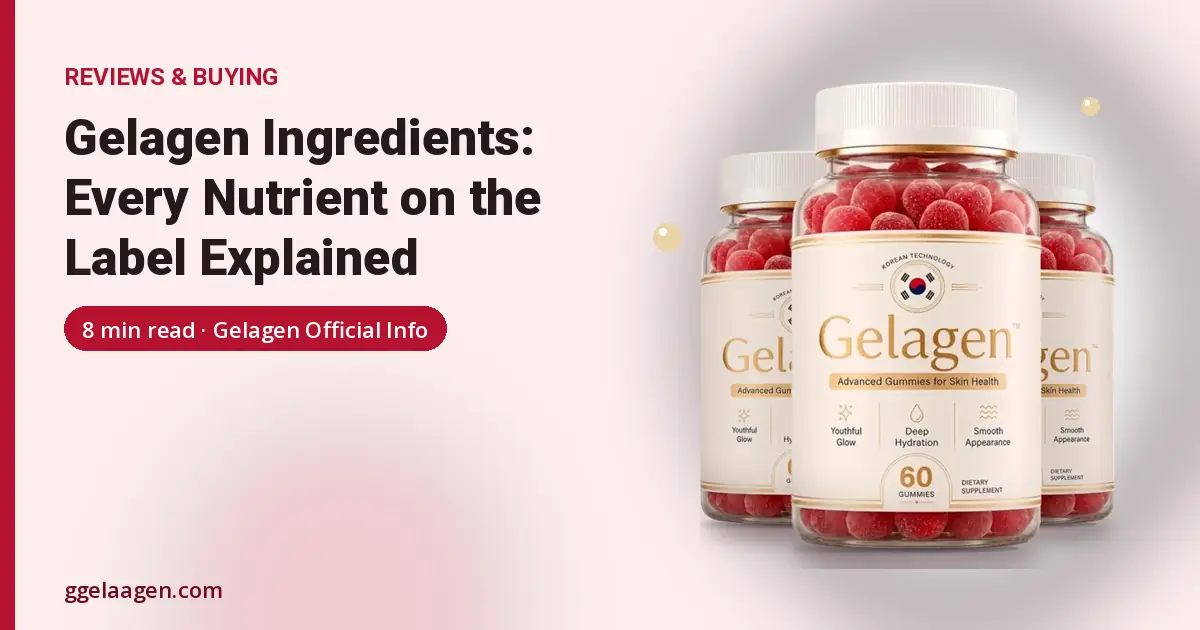
Gelagen declares 13 nutrients, and the 8 that do most of the work have printed amounts per two-gummy serving: biotin 5000 mcg, folate 442 mcg DFE, vitamin A 630 mcg, vitamin C 20 mg, vitamin D 10 mcg, vitamin E 7.4 mg, vitamin B12 6 mcg as methylcobalamin, and zinc 2.7 mg.
That means you can check each one against independent sources. The NIH vitamin A fact sheet, for instance, explains upper limits and why intake from all sources should be added together. Our full breakdown is in Gelagen ingredients explained, and the ingredients section on the homepage shows the panel at a glance.
Being transparent also means being clear about what is not inside. Gelagen contains no collagen. It provides vitamin C, which your body uses to build its own collagen; our article on vitamin C and collagen explains how.
A quick blend-spotting exercise
| Label shows | What you know | What you do not know |
|---|---|---|
| Biotin 5000 mcg | Exact dose per serving | Nothing important is hidden |
| Skin Complex 300 mg (hyaluronic acid, grape seed, bamboo, ceramides) | The four ingredients add up to 300 mg | Whether any single one is present in a meaningful amount |
| Collagen boosters (no amount) | Very little | What is inside, or how much |
Once you have seen this pattern, you will notice it everywhere. Our guide on reading a supplement facts label walks through the rest of the panel in about two minutes.
Choosing with confidence
Not every blend is a scam, and not every product with printed amounts is right for you. But printed amounts give you the power to decide. They let you check doses against the NIH guidance for supplement users, compare price fairly and talk to your doctor with real numbers.
If you want the full overview of how Gelagen compares, the complete Gelagen guide brings everything together. And if the label fits what you are looking for, compare Gelagen packages to find the supply that matches a 12-week trial.
Also worth reading: Biotin for Hair and Nails: What the Evidence Actually Says and Gelagen Price: 2, 3 or 6 Bottles – Which Package Saves Most?.
Frequently asked questions
Are proprietary blends bad?
Not automatically, but they limit what you can know. Because only a total weight is shown, you cannot see whether each ingredient is present in a meaningful amount, compare products fairly or add up overlap with other supplements.
Does Gelagen use a proprietary blend?
Gelagen prints individual amounts for its 8 key nutrients per two-gummy serving, including biotin 5000 mcg, vitamin C 20 mg, zinc 2.7 mg and vitamin A 630 mcg, so you can check each one yourself.
How can I tell if an ingredient is a token dose?
In a blend, ingredients are listed by weight from most to least. Anything near the end of a long list inside a small total weight is likely present in only a small amount. Without a printed number, you cannot be sure.
Safety note: Gelagen contains 5000 mcg biotin (tell your lab before blood tests) and 630 mcg vitamin A (ask your doctor first if pregnant, trying to conceive or breastfeeding). This article is educational and not medical advice. See our disclaimer.