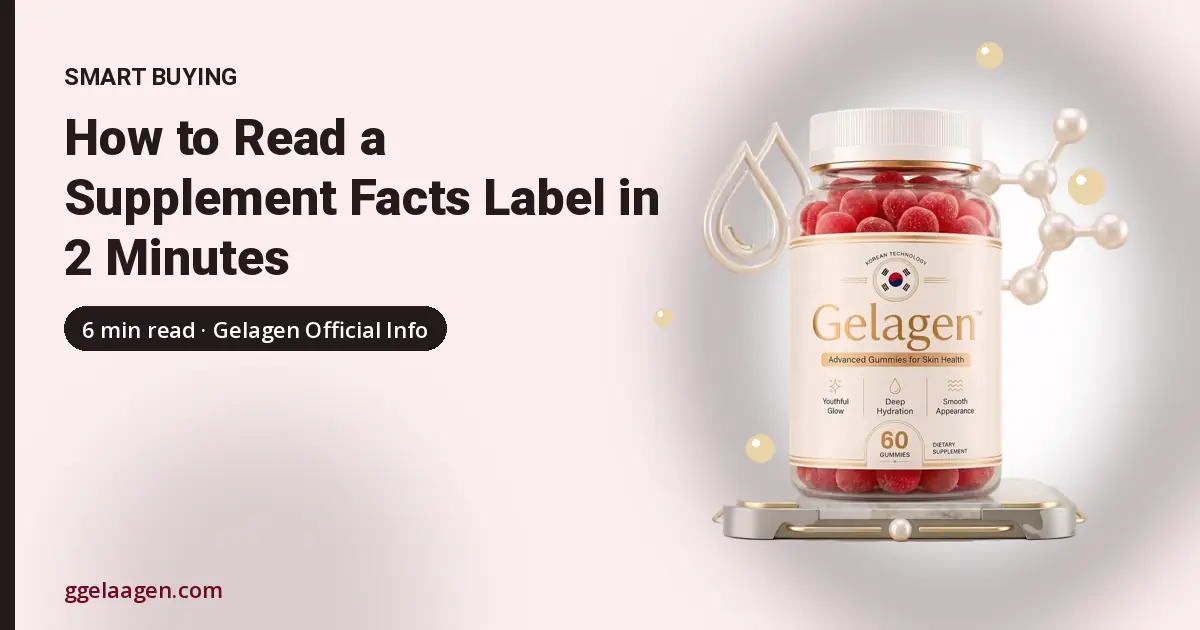
Start with the serving size, then read each nutrient's printed amount and %DV for that serving. Check for proprietary blends without amounts, scan the other ingredients for sugars and allergens, and confirm the manufacturer and facility details. Printed, specific amounts let you compare products and avoid doubling up.
Key takeaways
- Serving size first: everything else is per serving
- Printed amounts beat vague blends every time
- %DV shows how a dose compares with daily needs
- Check other ingredients for sugar, allergens and the gummy base
Why the back of the bottle matters more
The front of a supplement bottle is marketing: soft colours, big promises, a pretty model. The back is where the useful information lives, in a box titled Supplement Facts.
Once you know the layout, you can read any panel in about two minutes. That skill protects your money and helps you avoid taking too much of one nutrient when you combine products.
The 2-minute method
- Serving size (15 seconds). Is it one gummy, two gummies or three capsules? Every number below refers to that serving, not to a single piece.
- Servings per container (10 seconds). This tells you how long a bottle lasts. Sixty gummies at two per serving is a 30-day supply.
- Nutrient list and amounts (45 seconds). Look for specific units: mcg, mg or mcg DFE for folate. Note anything with an unusually high %DV.
- Blends (15 seconds). A named blend with only a total weight hides how much of each ingredient you get.
- Other ingredients (20 seconds). Sugars, the gelling agent, colours, flavours and allergens appear here.
- Who made it (15 seconds). Look for the manufacturer details and facility statements.
Understanding %DV
The percent Daily Value compares the amount in one serving with a reference daily intake. It is a quick way to see whether a dose is modest or large.
A %DV well above 100 is not automatically a problem, since some nutrients are well tolerated at higher intakes, but it is a cue to read more. Biotin is a good example: many beauty supplements contain far more than the daily value, and high intakes can interfere with some lab tests. The FDA biotin safety communication explains why, and our article on Gelagen and blood tests puts it in plain language.
Quick tip: If you take two products, add up the amounts of overlapping nutrients such as vitamin A, zinc and biotin. Our guide on taking Gelagen with a multivitamin shows how.
A worked example: the Gelagen panel
Here is how the method applies to a real product. Gelagen declares 13 nutrients, and 8 of them have printed amounts per two-gummy serving:
| Nutrient | Per serving (2 gummies) |
|---|---|
| Biotin | 5000 mcg |
| Folate | 442 mcg DFE |
| Vitamin A | 630 mcg |
| Vitamin C | 20 mg |
| Vitamin D | 10 mcg |
| Vitamin E | 7.4 mg |
| Vitamin B12 (methylcobalamin) | 6 mcg |
| Zinc | 2.7 mg |
The base is fruit pectin rather than gelatine, the product contains sugars (listed on the bottle panel), and it contains no collagen. For a nutrient-by-nutrient breakdown, see Gelagen ingredients explained.
Red flags to watch for
- A proprietary blend with one total weight and no individual amounts. Our explainer on proprietary blends covers why that matters.
- Disease claims, such as promises to fix a medical condition. Supplements are not allowed to make them.
- Claims that a product is approved by the FDA. The agency does not approve supplements, so wording like that tells you the brand is either confused or stretching the truth. A correct statement refers to an FDA-registered, GMP manufacturing facility instead.
- No manufacturer name or contact details.
The NIH consumer guide to dietary supplements is a useful checklist to keep bookmarked.
Put it into practice
Next time you are tempted by a beauty supplement, flip it over and run the two-minute check before you buy. You will quickly spot which brands give you real information.
It also helps to keep a simple note on your phone listing every supplement you take, with the serving size and the key amounts. When a doctor or pharmacist asks what you are taking, you can answer accurately in seconds, and you will notice straight away if a new product would push one nutrient too high.
If you are comparing beauty formulas specifically, our side-by-side of Gelagen vs drugstore hair, skin and nails vitamins uses exactly this method, and Gelagen vs collagen powder shows how to compare two very different product types fairly.
If you have read the Gelagen panel and it fits your needs, the complete Gelagen guide walks through everything else, and you can compare Gelagen packages when you are ready.
Also worth reading: Gelagen Results Timeline: Week 1 to Week 12 and Zinc for Skin: Healing, Oil and Everyday Support.
Frequently asked questions
What does %DV mean on a supplement label?
Percent Daily Value compares the amount in one serving with a reference daily intake. It helps you see quickly whether a dose is small or large, and whether combining products might add up to more than you intended.
Why is serving size so important?
Every amount on the panel refers to one serving. If a serving is two gummies, the numbers are for two gummies, not one. Misreading this is the most common way people under- or overestimate what they take.
What is a red flag on a supplement label?
Watch for proprietary blends without individual amounts, disease claims, wording that suggests FDA approval, and missing manufacturer details. Clear, printed amounts per serving are a sign the brand is being transparent.
Safety note: Gelagen contains 5000 mcg biotin (tell your lab before blood tests) and 630 mcg vitamin A (ask your doctor first if pregnant, trying to conceive or breastfeeding). This article is educational and not medical advice. See our disclaimer.